



Curriculum
The Cottesloe School Curriculum Intent Statement
At The Cottesloe School, our guiding principle of ‘Prepare, Aspire, Succeed’ is the heartbeat of the ‘Cottesloe Journey’. We believe that education is about more than just academic results; it is about learning about and from the world in which we live. This journey is not a uniform path; instead, it empowers every student - regardless of ability, need, or background - to develop the aspirations required to become the very best version of themselves.
What is the curriculum? “The curriculum is a framework for setting out the aims of a programme of education, including the knowledge, understanding and skills to be gained at each stage (intent); for translating that framework over time into a structure and narrative, within an institutional context (implementation) and for evaluating what knowledge and skills pupils have gained against expectations (impact/achievement).”
At The Cottesloe School, our guiding principle of ‘Prepare, Aspire, Succeed’ is the heartbeat of the ‘Cottesloe Journey’. We believe that education is about more than just academic results; it is about learning about and from the world in which we live. This journey is not a uniform path; instead, it empowers every student – regardless of ability, need, or background – to develop the aspirations required to become the very best version of themselves.
To achieve this, we provide a progressive, deep, and knowledge-rich curriculum that is purposefully sequenced and imaginative, encompassing the widest range of disciplines: Arts, Sciences, Humanities, Technologies, Maths, Literacy, Languages and Sports. Our curriculum is built on a foundation of equity of opportunity; we ensure that inclusion is not something that happens ‘elsewhere,’ but is a universal offer found in every classroom through adaptive teaching and high expectations.
Our curriculum evokes a sense of curiosity and encourages questioning, which deepens students’ understanding. Character development is central to our mission; we explicitly teach our students how to be good people through our Healthy Relationships framework and our 6Cs: Collaboration, Cooperation, Creative Thinking, Critical Thinking, Challenge, and Coaching. These learning habits, combined with challenging goals, enable our students to become increasingly independent young people who can achieve their full potential.
By providing personalised support through our Strands of Inclusion, we empower students to overcome barriers and take ownership of their learning. Our curriculum is a blend of the past, present, and future that equips students with a rich set of contemporary skills and historical knowledge. It offers a range of experiences for students of all abilities and backgrounds, ensuring they are prepared to make positive contributions to their families and their community.
Ultimately, we educate the whole child: supporting their artistic appreciation, encouraging them to question the world around them, nurturing sporting talents, and fostering a strong sense of personal responsibility. We prepare our students to leave us as compassionate, informed, and active citizens, ready for their next steps in learning and life, equipped with the knowledge and skills to make a positive contribution to their families, their community, and the wider world.
Curriculum Implementation – What is studied?
The curriculum is taught across a two-week, fifty-period timetable of one-hour lessons for all year groups. A student's Week 1 timetable is likely to be slightly different to their Week 2 timetable.
In both KS3 and KS4, students are taught in ability-based sets in the core subjects of English, Maths, Science and PE so that learning can be effectively tailored. This setting is flexible and reviewed regularly to ensure students are most appropriately placed. In other subjects, students are taught in mixed ability groups.
Key Stage 3 | Years 7 to 9
We are required to follow the National Curriculum at Key Stage 3.
Year 7 and Year 8
Across a fortnight, all students in Years 7 and 8 study:

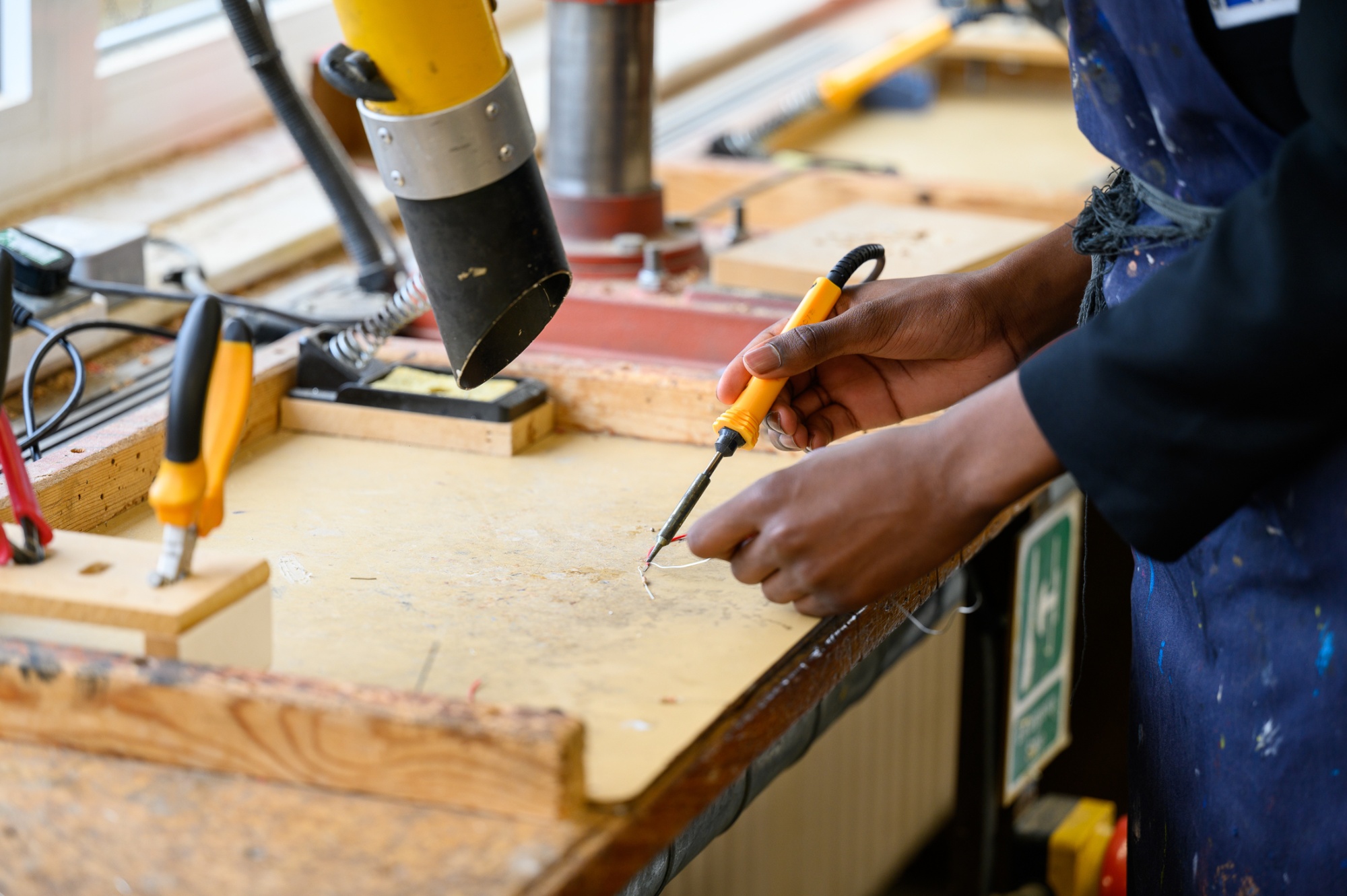
Art and Design & Technology is taught through a carousel. Students will have the opportunity to participate in intense, thematic learning in art and design, food technology and design and technology, experiencing each subject at least once in rotation, across an academic year.
Modern Foreign Languages
At Key Stage 3, students embark on an exciting journey into the world of modern foreign languages. Every student is allocated either French or German upon starting Year 7 and continues to study this single language throughout Years 7, 8, and 9. This focused approach allows for a deep and thorough understanding of the language and its associated culture. The curriculum is designed to build a strong foundation in listening, speaking, reading, and writing, fostering confidence and communication skills. Students will have the opportunity to continue their language studies at GCSE, by opting for the language they have studied at KS3, building upon the knowledge and skills already developed.
We recognise and celebrate the linguistic diversity of our student body. Students who speak a language other than English at home may have the chance to be entered for a GCSE in that language. This can be a fantastic way to gain an additional qualification and have their linguistic skills formally recognised. To learn more about this process and the available options, please visit: cottesloe.bucks.sch.uk/curriculum/examinations/home-language-gcses
Year 9
The curriculum is largely similar to that of Years 7 and 8. However, students study three choice subjects, chosen from a suite of Creativity and Enrichment subjects, in readiness to make KS4 Options in the Spring term of Year 9.

Key Stage 4 Overview
At The Cottesloe School, we operate a two-year Key Stage 4, running through Year 10 and Year 11, although Mathematics and Science begin their formal Key Stage 4 curricula during Year 9. The vast majority of our students follow a core curriculum consisting of English Literature, English Language, Mathematics, and Science (either Combined or Separate).
To ensure every student maintains a broad and balanced curriculum, we ask that they select at least one subject from History, Geography, or the language they have studied during Key Stage 3 (French or German). Many students choose to study a combination of these subjects to provide a versatile foundation for their future steps.
We are proud of the flexibility our curriculum offers, ensuring we cater for individual needs at all levels. Our model allows for bespoke choices; for example, more able students may choose to study both Humanities and a Language, along with a fourth option, or take an additional GCSE in Statistics. Conversely, where appropriate, some students may benefit from a more tailored approach that includes additional support in core Mathematics and English by undertaking Functional Skills. Guided by our commitment to equity of opportunity, we ensure that students’ SEND and EHCP requirements are fully accommodated. This inclusive approach ensures that every student follows a path that empowers them to achieve their full potential.
There is also a wide variety of option subjects that students can select from. We offer a range of qualification types to suit different learners; these include GCSE, Cambridge Nationals (OCR), and WJEC qualifications.