






Understanding Russell Group Universities
When researching higher education options, you will frequently hear the term "Russell Group". Understanding what this group represents can help you decide if these institutions align with your academic and career goals.
What is the Russell Group?
The Russell Group is an association of 24 leading research-intensive universities across the UK. Often compared to the US Ivy League, these institutions receive a significant portion of all university research grant funding in the UK. They are known for high academic standards, world-class facilities, and strong international reputations.
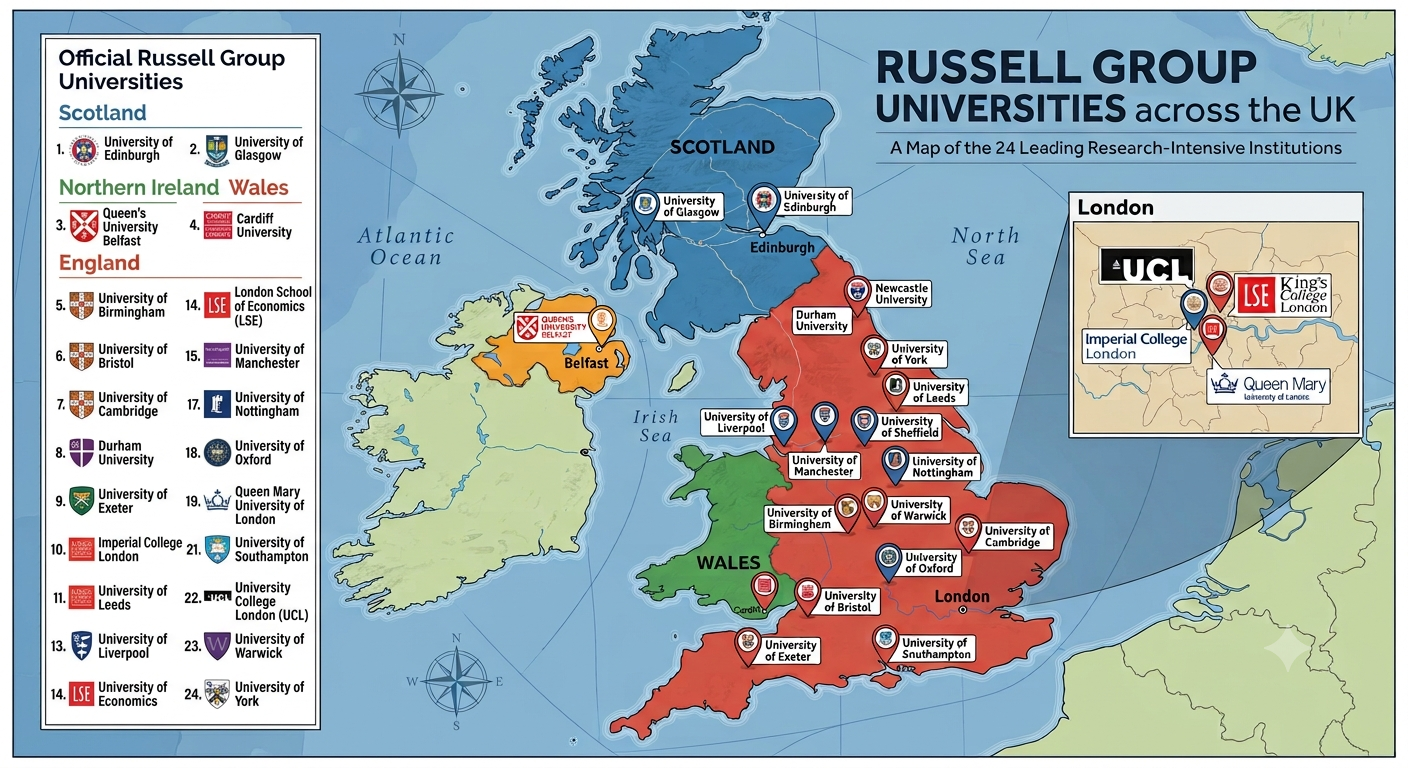 Which Universities are in the Russell Group?
The 24 member universities are:
-
England: University of Birmingham, University of Bristol, University of Cambridge, Durham University, University of Exeter, Imperial College London, King's College London, University of Leeds, University of Liverpool, London School of Economics and Political Science (LSE), University of Manchester, Newcastle University, University of Nottingham, University of Oxford, Queen Mary University of London, University of Sheffield, University of Southampton, University College London (UCL), University of Warwick, University of York
- Scotland: University of Edinburgh, University of Glasgow
- Wales: Cardiff University
- Northern Ireland: Queen's University Belfast
Why Consider a Russell Group University?
- Research-led Teaching: Lecturers and professors are often active researchers at the forefront of their fields, bringing the latest discoveries into the classroom.
- Employer Recognition: Graduate recruiters around the world highly value degrees from Russell Group institutions due to their academic rigour.
- Networking and Resources: Excellent library collections, state-of-the-art laboratories, and extensive alumni networks can provide a boost to your post-graduation career.
Debunking the Myths: Is a Russell Group University Essential?
No. While Russell Group universities are prestigious, they are not the only route to a successful career or high-quality education.
- Course-specific Excellence: Some of the UK’s top-ranked courses for specific subjects (such as Architecture, Design, Sport Science, Agriculture, or Creative Arts) are at non-Russell Group institutions like Loughborough, Bath, or specialist conservatoires.
- Teaching vs Research: Russell Group universities place a heavy focus on research. If you prefer smaller class sizes or practical, vocational learning, other institutions may offer a better environment for your learning style.
- Fit Matters Most: The best university for you is one where you will thrive academically, socially, and personally.
What Entry Requirements Should You Expect?
Most Russell Group universities typically set higher entry requirements, generally looking for grades ranging from A*AA to ABB at A Level (or equivalent BTEC or T-Level qualifications). They often favour traditional academic subjects, so it is important to check individual course requirements early in Year 12.
Don’t limit your UCAS choices purely to a badge or brand name. Use tools like Unifrog and UCAS Hub to compare course modules, graduate employment rates, and student satisfaction ratings across all universities before finalising your choices.